

The Creator Economy Is Not Running Out of Influence. It Is Running Out of Patience.

For the past decade, the dominant assumption in marketing has been that the creator economy would keep expanding indefinitely. More creators. More platforms. More formats. More campaigns. More dashboards measuring more impressions across more channels. The model seemed self-reinforcing. Audiences trusted creators more than they trusted brands, so brands paid creators, and the whole ecosystem grew.
But something shifted this week that deserves more than a passing mention in a media newsletter.
Vogue Business reported on August 3rd that creators are facing dramatically higher production and strategic expectations while audiences are simultaneously growing tired of generic, overly scripted brand content. Brands increasingly want creators to function as cultural consultants, art directors, multi-format production teams, strategists, and long-term ambassadors. Not people who publish a sponsored post. Entire creative departments, contracted at influencer rates, expected to deliver at agency quality. And at the same time, the audiences those creators built? They are tuning out the very content brands are paying so much to produce.
So brands are asking creators to do more. Audiences are asking brands to do less. And somewhere in the middle, the economics of manufactured authenticity are beginning to crack.
That is worth sitting with for a moment.

What Happens When Authenticity Becomes an Industrial Product?
The original promise of the creator economy was simple and genuinely radical. Real people with real expertise, real opinions, and real communities could reach audiences in ways that polished corporate advertising never could. The creator was valuable precisely because they were not a brand. Their recommendation carried weight because it came from a person, not a media buy. Their audience trusted them because the relationship had been built over time, through consistency, personality, and honest engagement.
Then brands discovered the model worked. And they did what brands inevitably do with things that work. They scaled it.
Scripts got tighter. Brand guidelines got longer. Approval processes got more complicated. The number of required deliverables per campaign grew. The authentic storyteller became a production unit. The creative partner became a vendor. And the audience, which had originally chosen to follow a person they trusted, began to notice that something had changed.
Can you manufacture authenticity at industrial scale? The answer this week's data is giving us is an increasingly clear no.
Platforms Are Drawing the Same Conclusion
The behavioral reset is not only happening at the audience level. Major platforms are simultaneously tightening the rules around low-effort, mass-produced content. YouTube has clarified its intention to reward original storytelling rather than repetitive output. TikTok is testing stronger detection systems for AI-generated spam. And Snap announced on July 31st that fully AI-generated Spotlight videos will no longer qualify for recommendation or rewards.
These are not minor policy adjustments. They are platforms signaling, clearly and in coordination, that the content economy is approaching a quality floor. Below that floor, content does not get distributed. It does not get recommended. It does not get rewarded. It simply disappears.
Ask yourself what this means for a marketing strategy built entirely around content volume. If the platforms themselves are beginning to filter out mass-produced, low-differentiation content, what exactly is the return on producing more of it?
The market is not asking for more content. It is asking for more genuine human participation. And those are not the same thing.
Nano-Creators and the Return of Relevance
One of the most telling signals from this week is the accelerating shift toward nano-creators—people with audiences as small as 500 followers. Major brands are recruiting everyday customers and micro-community participants not because they cannot afford larger creators, but because relevance has begun to outperform reach in measurable ways.
This is not a budget decision. It is a trust decision.
A customer who genuinely uses a product and talks about it to 500 highly connected people in a specific professional or personal community may generate more meaningful commercial activity than a creator with millions of followers who has promoted seventeen competing products in the same month. The audience knows the difference. They have always known the difference. It just took the market a while to catch up.
But here is the question brands are not asking loudly enough: if the most valuable form of creator participation is genuine community members sharing real experiences with relevant networks, why are brands still treating that participation as a campaign deliverable? Why is the answer always another brief, another contract, another set of deliverables, another dashboard?
What if the participation itself was the point—and the brand's job was to build an environment worthy of it?
The Infrastructure Problem Nobody Is Solving
Amaze described its newly launched platform this week as an operating system for creators, bringing brand development, products, commerce, and multiple revenue pathways into one connected ecosystem. The underlying observation embedded in that announcement is especially worth examining. Social platforms gave creators audiences. They did not give creators the infrastructure required to build lasting economic value from those audiences.
That gap—between having an audience and owning the asset—is the central tension of the creator economy. It is the same tension brands have been living inside for years without fully naming it. Brands built followings on platforms they do not own. Creators built audiences on infrastructure they do not control. Both groups kept producing content that made someone else's platform more valuable, and both groups are now beginning to feel the consequences of that arrangement.
So what does the right infrastructure actually look like?
The Pivot Most Marketers Are Still Missing
When marketers read this week's signals, most will reach for a familiar solution. More authentic creator campaigns. Thousands of nano-influencers managed through a new platform. Automated creator management tools. Better attribution dashboards. More deliverables produced at human scale but distributed at algorithmic speed.
That still treats human participation as campaign inventory.
It is a better version of the same fundamental mistake—the assumption that what the market needs is more content flowing through rented infrastructure. It does not. What the market needs is owned environments where customers, creators, employees, partners, and experts can continuously contribute stories, introduce their networks, and build authority together in a way that creates lasting value for everyone involved.
Consider the difference between giving a customer an affiliate link and featuring that customer in a published interview on your brand's media platform. The affiliate link is transactional. The feature is relational. The link disappears when the campaign ends. The article compounds. The customer with the affiliate link is a sales mechanism. The customer who was published is a distribution partner who shares the story with their entire network because they are proud to be part of it.
Which of those two relationships scales? Which one builds something the brand actually owns?

What Owned Media Actually Means
There is a version of this conversation that collapses into a familiar argument about building an email list or launching a podcast. That is not what we are talking about here.
Owned media, in the sense that matters, is participatory media. It is a platform where the brand has created the infrastructure and the community provides the content, the credibility, the distribution, and the ongoing reason to return. It is the same insight that made social networks powerful—except the participation happens inside an environment the brand controls, the archive belongs to the brand, and every contributor, reader, sponsor, and story strengthens an asset the brand owns rather than a platform it is renting.
Creators have stories. Customers have experiences. Employees have expertise. Partners have relationships. Communities have distribution. Give all of them a campaign brief and you may get another post that lives for 72 hours before the algorithm buries it. Give them a platform where they can be interviewed, published, discovered, and celebrated—and every contribution creates authority for the person who contributed, distribution for the ecosystem, and lasting value for the brand.
The creator economy is not running out of influence. It is running out of patience with being treated like a content supply chain. The audiences those creators built are not disappearing. They are simply becoming more selective about what they will give their attention to and what they will trust enough to act on.
The Brands That Win the Next Decade Will Not Simply Hire More Creators
They will build something creators, customers, and communities actually want to belong to.
That is the distinction behind AmpLever. We are not in the business of helping brands manufacture more content for rented platforms. We license the infrastructure for brands, associations, platforms, universities, cities, and professional communities to become the media company their ecosystem publishes on. Structured categories. Contributor workflows. Editorial positioning. Publishing infrastructure. Sponsorship inventory. Onboarding systems. The foundation a brand needs to stop producing programming for someone else's platform and start accumulating an asset of their own.
The social platforms will continue to be the most powerful distribution systems ever created, and brands should continue using them. But distribution is not ownership. A profile is not a publication. Followers are not an audience you own. And a campaign that generates a hundred thousand impressions this week and nothing next month is not building the kind of compounding asset that the next decade of marketing is going to reward.
The question is not whether creator marketing works. It clearly does. The question is where the value from that creator marketing accumulates when the campaign ends.
If the answer is always someone else's platform, it may be time to build something of your own.
AmpLever licenses the infrastructure that makes that possible.
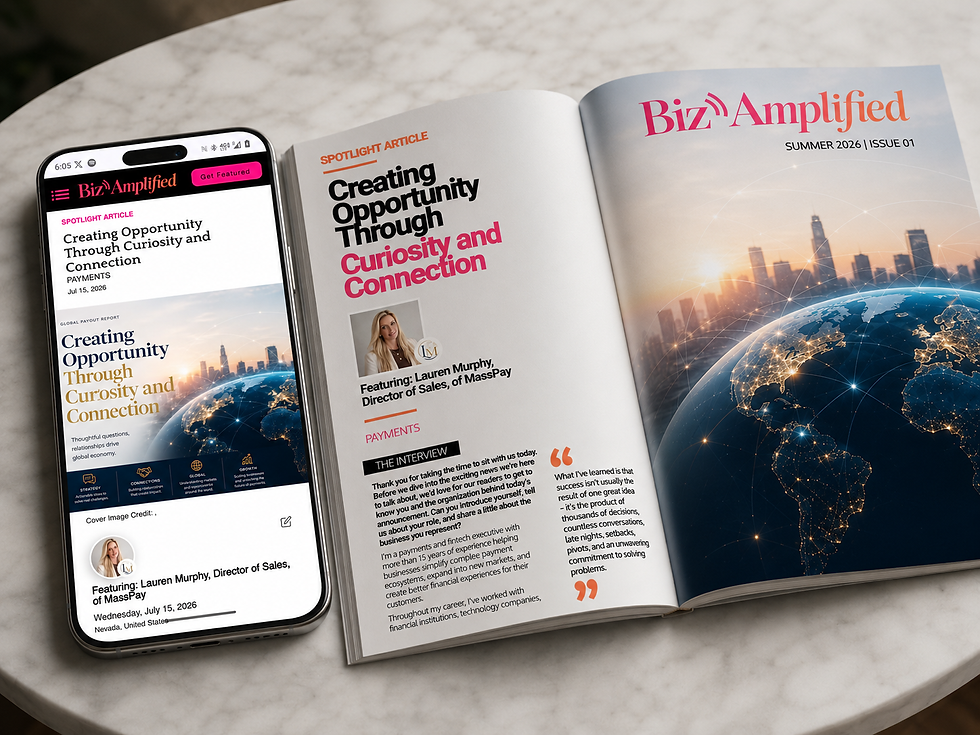
About AmpLever
AmpLever helps brands, organizations, and community leaders become the media platform for the people they already serve.
Most businesses spend their time creating content for social networks they do not own. Their customers, creators, partners, employees, and members generate attention, engagement, and credibility—but much of that value remains trapped inside someone else’s platform.
AmpLever changes the model.
We license and launch branded, contributor-powered digital magazines where your community can publish stories, share expertise, announce milestones, and participate in the conversations shaping your industry. Those contributors then distribute their features through their own networks, bringing new readers, relationships, and opportunities back to a platform you control.
Your community creates the stories.
Your contributors expand the distribution.
Your brand owns the media.
This is more than content marketing. It is an owned-media asset designed to build authority, strengthen relationships, create long-term visibility, and open new revenue opportunities through sponsorships, advertising, memberships, events, directories, awards, and premium features.
You do not need to build the next Facebook, LinkedIn, or Forbes.
You need to become the most important media platform in your industry, profession, city, association, or community.
AmpLever.com — Amplifying Leverage.


Comments