
Mark Zuckerberg Made $668 Million Today. Your Marketing Team Helped Build the Business Model.

AmpLever.com | The Business of Owned Media and Participation Media
Every morning, millions of business owners wake up and begin creating content for Facebook and Instagram. They hire social media managers, photographers, videographers, copywriters, designers, strategists, and entire marketing agencies to produce a steady stream of posts, videos, stories, and reels. They invest time, talent, creativity, and money into building audiences, generating engagement, and staying visible on platforms they do not own. And while those businesses compete for attention, Meta has built one of the most profitable advertising ecosystems in history around the activity happening on those platforms.
Consider the number in the accompanying graphic: $668 million in a single day. According to Meta's second-quarter 2026 financial results, the company generated $60.8 billion in revenue over 91 days, equivalent to approximately $668 million per day. That's a quarterly average, not an independently verified amount earned on a particular day, and it represents Meta's corporate revenue rather than Mark Zuckerberg's personal income. But the underlying number is real, and it reveals something remarkable about the economics of modern marketing.
Businesses spend money creating content. People spend time consuming and sharing it. Meta has built the infrastructure that monetizes the attention generated by both.
The question isn't whether Facebook and Instagram are valuable marketing channels. Of course they are, and millions of businesses have benefited from their ability to reach customers, establish relationships, and generate sales. The more important question is whether businesses have become so focused on participating in someone else's media ecosystem that they've forgotten to build one of their own. At what point does investing in social media stop being an audience-building strategy and start becoming an expensive habit of continually renting access to the audience you've already helped attract?

The $668 million question
Meta's financial performance is impressive by almost any measure. During the second quarter of 2026, the company reported revenue growth of 28% compared with the same period in 2025, while the number of advertisements delivered across its Family of Apps increased by 14%. The average price per advertisement also increased by 12%, meaning Meta was generating more advertising activity while charging more, on average, for that activity. Meanwhile, approximately 3.6 billion people used at least one of Meta's family of applications daily during June 2026.
Q2 2026 revenue
$60.8B
Up 28% year over year
Average daily revenue
$668M
Calculated over 91 days
Daily active people
3.6B
June 2026 average
Ad impressions
+14%
Year-over-year growth
Source: Meta Platforms, second-quarter 2026 financial results, released July 29, 2026.
These figures describe a company that has mastered something most businesses are still struggling to understand: the economics of participation. Meta doesn't need to personally create every post, photograph, video, discussion, or story that keeps people returning to its platforms. Its users, creators, businesses, publishers, and advertisers generate enormous amounts of activity, while Meta provides the infrastructure for distribution, discovery, engagement, and advertising. The company invests heavily in technology, security, moderation, infrastructure, and product development, but its extraordinary reach would be impossible without the billions of people participating in its ecosystem.
And that is where the business lesson becomes uncomfortable. Many companies look at Meta's platforms and see places where they need to advertise, publish, and compete for visibility. They rarely stop to consider that the very business model they're paying to participate in could teach them how to build something of their own. What if the most important lesson from Facebook isn't how to advertise on Facebook, but how to create a system where your community helps generate the media?
You are paying people to build content for someone else's platform
Think about what happens inside a typical business marketing department. Someone creates a content calendar, another person designs graphics, someone writes captions, a videographer produces short-form content, and a marketing manager schedules everything across several social platforms. The business measures impressions, likes, comments, shares, follower growth, and occasionally conversions, then starts preparing the following week's content. For many organizations, this process has become so routine that few people question whether the activity is creating a lasting asset or simply maintaining visibility.
Now consider where the finished work lives. The business may own its original creative materials, but the social platform controls how those materials are displayed, recommended, monetized, and distributed within its service. The platform establishes the rules, determines which formats receive priority, decides how advertising is priced, and controls the systems that connect publishers with audiences. Businesses can develop valuable relationships through these channels, but they cannot assume that the same followers will continue seeing the same content under the same conditions.
This creates a distinction that often gets lost in conversations about social media marketing. Owning your content is not the same as owning the infrastructure through which people discover and consume that content. A business can own every photograph, video, and article it produces while remaining heavily dependent on another company's platform for distribution. When visibility declines, the usual response is to create more content, experiment with different formats, or increase advertising expenditures, rather than examine whether the business should also be building a direct relationship with its audience.
None of this means social media marketing is inherently wasteful. For many businesses, advertising on Facebook and Instagram produces measurable returns, generates customers, and provides access to audiences they could not efficiently reach through other channels. The problem arises when paid and organic social activity become the entire strategy rather than components of a larger system. A successful advertising campaign can generate revenue today, but an owned media strategy can also build an asset that continues creating value tomorrow.
The platforms understood something brands still overlook
Facebook didn't become successful because Mark Zuckerberg personally created billions of pieces of content. It created an environment where people had compelling reasons to contribute their own photographs, opinions, relationships, milestones, and conversations. As participation increased, the platform became more useful to other participants, creating additional reasons for people to join and remain engaged. Advertising was eventually layered onto an ecosystem whose value was already being continuously reinforced by the activity of its users.
Instagram followed a similar underlying principle, although its product, audience behavior, and content formats evolved differently. Creators publish photographs and videos, businesses share products and experiences, and users engage with the people and subjects they care about. The platform facilitates discovery and distribution, and advertisers pay to reach people participating in that environment. The critical insight is that the company operating the platform is not responsible for manufacturing every piece of content that makes the platform valuable.
Most businesses, however, continue approaching marketing as a production problem. They ask how many posts their team should create, how frequently they should publish, how much content their agency can deliver, and how much advertising is required to distribute it. Those are legitimate operational questions, but they overlook a potentially more valuable strategic question. Who already has a reason to create and share stories connected to our business, and what would happen if we gave those people a platform of their own?
Imagine a retailer with 500 independent businesses selling its products. Instead of building its entire marketing strategy around promoting the parent brand, it could create a media publication featuring those retailers, their founders, their communities, their customers, and their successes. Each featured retailer would have a reason to share its story with its own customers, introducing new audiences to a publication operated by the parent company. The resulting publication could become a shared resource that strengthens relationships across the distribution network while giving every participant additional visibility.
The same principle applies to almost any organization with an existing community. Associations have members, conferences have speakers and exhibitors, franchises have franchisees, brokerages have agents, and brands have customers, employees, suppliers, and partners. Each group contains people with stories, expertise, achievements, and relationships that may be relevant to the broader audience. Yet many organizations spend significant amounts of money creating promotional content about those communities without inviting the communities themselves to become part of the publishing process.
The evidence suggests platform dependence carries real risk
The challenges associated with relying on third-party distribution are not merely theoretical. The Reuters Institute's 2025 journalism and technology research, drawing on Chartbeat data, reported that referral traffic from Facebook to hundreds of news websites had fallen by 67% over the preceding two years. Traffic from X, formerly Twitter, had declined by approximately 50% over the same period, illustrating how significantly changes in platform behavior and distribution can affect publishers. These figures describe news and media properties rather than every type of business, but they provide a clear example of the risks associated with dependence on external traffic sources.
The Reuters Institute's 2026 Digital News Report identified another important development. Across the 48 markets studied, social media and video networks had become more popular sources of news than publishers' own websites and applications in 30 markets. The report also highlighted the growing challenge facing news organizations as audiences increasingly consume information through intermediaries rather than visiting the original publisher. For businesses attempting to develop direct audience relationships, this shift illustrates why simply producing valuable content does not guarantee that audiences will encounter it on properties the business controls.
This is a particularly important distinction as artificial intelligence changes how people discover information. Search engines, recommendation systems, social feeds, and AI-generated answers increasingly mediate the relationship between publishers and their potential audiences. Organizations can invest heavily in creating useful information while receiving fewer direct visits if consumers obtain what they need through another interface. The response should not be to abandon discovery platforms, but to create compelling reasons for audiences to establish relationships directly with the organizations producing the information.
For businesses, that means thinking beyond followers and impressions. A company with a recognizable publication, repeat visitors, an engaged contributor network, direct subscribers, advertiser relationships, and a library of valuable industry content has a different strategic position from a company whose entire audience exists inside a social platform. Both companies may have impressive reach, but the first has developed additional assets and channels through which its relationships can continue. The distinction becomes especially important when platform algorithms, advertising prices, competitive conditions, or customer behavior change.
What if your customers became your marketing department?
The phrase may sound provocative, but the concept is straightforward. Instead of expecting customers to perform unpaid promotional labor, businesses can create opportunities that provide meaningful value to the people who participate. A customer may appreciate having their success story published, a business owner may value professional recognition, an employee may welcome the opportunity to demonstrate expertise, and a partner may benefit from being introduced to a wider audience. When those stories are published professionally, participants often have a natural reason to share them.
Consider a real estate brokerage operating in a competitive metropolitan market. Its agents may spend considerable time producing property tours, market updates, social media videos, and promotional content designed to establish credibility with potential buyers and sellers. Now imagine the brokerage also operates a local online publication that features neighborhood businesses, community leaders, nonprofit organizations, luxury properties, market developments, and the people shaping the region. Instead of only asking the community to pay attention to the brokerage, the brokerage becomes an organization that pays attention to the community.
A local restaurant owner featured in the publication has a reason to share the article with customers. A nonprofit director may introduce the story to donors and volunteers, while an entrepreneur may share their interview with employees, investors, and professional connections. Each participant creates an additional opportunity for readers to discover the publication and the organization behind it. The brokerage is no longer relying exclusively on its own marketing team to create every story or introduce every new audience.
This is a fundamentally different relationship between marketing and community. Traditional advertising often begins with the company's desire to communicate something about itself, while participation-based publishing begins with the stories and interests of the people around the company. Those stories can still support commercial objectives, but they provide a reason for people to engage that extends beyond being asked to buy something. Instead of constantly asking people to share your marketing, give them something about themselves that they genuinely want to share.
Participation Media: building a business around shared visibility
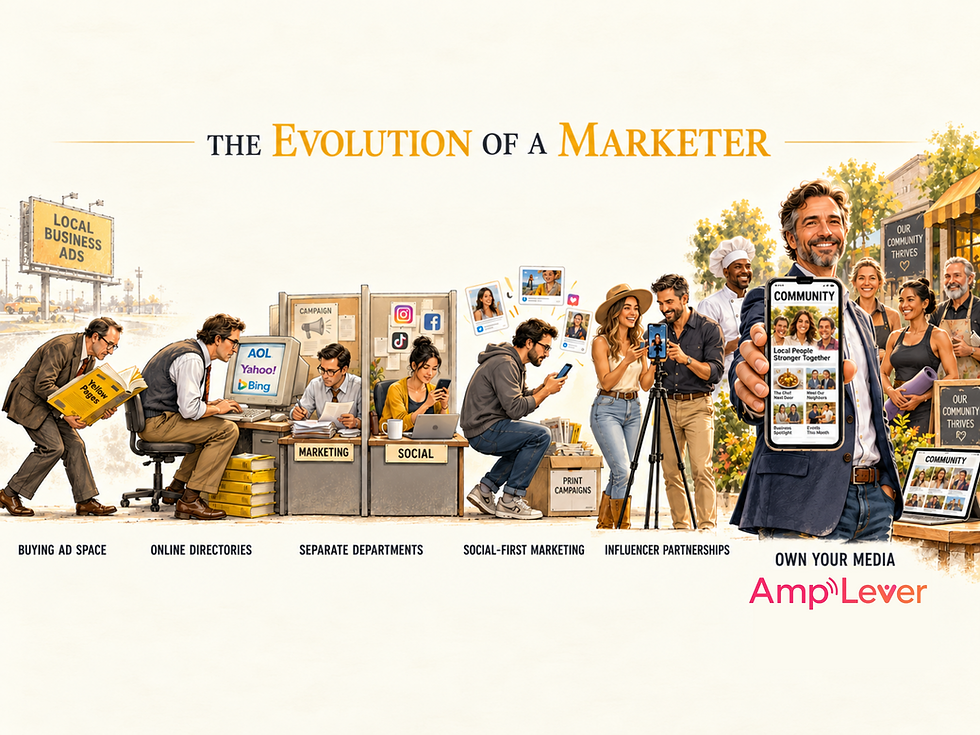
At AmpLever, we call this approach Participation Media, because it changes the role of the people surrounding a business. Traditional marketing generally treats customers as the audience receiving a message, while influencer marketing frequently pays selected individuals to distribute messages to their audiences. Participation Media invites the broader community to contribute stories, expertise, achievements, announcements, and perspectives to an ongoing publication. The publication becomes a shared destination where participation itself helps create reasons for new people to discover and engage with the organization.
The concept also changes how businesses think about content production. Instead of assigning a marketing employee to interview every person, write every article, collect every photograph, and coordinate every promotional post, organizations can provide structured tools that make contribution much easier. The business retains editorial leadership, standards, and oversight, but contributors take a more active role in creating and sharing their own stories. This makes it possible to expand the volume and diversity of published content without requiring the same proportional increase in traditional production resources.
Participation Media also creates opportunities for recognition and recurring engagement. A publication can feature business launches, employee achievements, community initiatives, product announcements, professional milestones, awards, industry perspectives, and upcoming events. These stories can serve the people being featured while also building an increasingly useful library of information for the wider community. Over time, the publication can become a destination associated with an industry, location, organization, or particular area of expertise.
This does not mean every participant will share every article or that every publication will automatically attract a substantial audience. Growth still depends on editorial relevance, publication quality, trust, consistency, effective distribution, and the willingness of people to participate. But it changes the underlying growth opportunity by creating a model in which the organization is not the only potential source of content or audience introductions. The business builds the platform, while the community helps build the value of participating in it.
Why owning the media matters more than ever
The word ownership deserves careful consideration because it can mean several different things in digital publishing. A company may own its brand, domain, editorial content, customer relationships, advertising agreements, and certain audience data without owning the software used to operate its publication. Businesses that license publishing technology should understand their contractual rights, including content ownership, data access, portability, and what happens if they eventually transfer or sell the publication. The goal is not necessarily to develop proprietary software from scratch, but to control the business relationships and media assets that create lasting value.
A company-owned publication can support several activities beyond conventional marketing. It can provide an editorial platform for customers and partners, generate sponsorship and advertising opportunities, showcase expertise, support industry events, recognize community achievements, and help build direct audience relationships. It can also create a recognizable brand associated with a particular market or community, potentially giving the organization a differentiated position that competitors cannot easily replicate through additional social posts. None of these outcomes is guaranteed, but they represent opportunities that a standalone content calendar generally does not provide.
Consider how differently two businesses might approach the same marketing budget. One invests primarily in producing content for third-party platforms and buying additional distribution whenever organic reach becomes insufficient. The other continues using those platforms but also invests in an owned publication, contributor relationships, recurring editorial features, and systems that encourage participants to introduce new audiences. Both businesses may generate immediate marketing results, but the second is deliberately accumulating assets and relationships that extend beyond individual campaigns.
This is not an argument against social media, and it is certainly not an argument that businesses should stop advertising on Meta's platforms. Facebook and Instagram remain useful tools for reaching customers, sharing stories, and driving commercial activity. The strategic opportunity is to change the role those platforms play within a business's larger media ecosystem. Social media can remain a powerful distribution channel without being the only place where a company's media value accumulates.
What AmpLever is building
This is the problem we set out to address with AmpLever. We provide businesses, associations, conferences, entrepreneurs, creators, and community leaders with the technology and publishing infrastructure to launch and operate their own branded online media publications. Think of a publication like Forbes, Entrepreneur, or a specialized industry magazine, but focused entirely on the people, organizations, and stories within a particular business ecosystem. Rather than requiring the organization to build a publishing platform from scratch, AmpLever supplies the underlying systems needed to operate one.
The publishing process is designed around participation rather than a traditional newsroom structure. An Editor-in-Chief or publication operator invites someone to be featured, and the invited person receives access to an automated interview experience. The contributor chooses the questions they want to answer, provides their responses, adds photographs, and publishes their story through the publication's workflow. The operator does not need to personally conduct every interview or write every article, allowing editorial leadership to focus more heavily on community relationships, publication direction, and opportunities for growth.
Once the article is published, the featured person has something tangible to share with their own audience. Their professional story, business achievement, expertise, or community contribution now exists within a branded media publication rather than appearing only as another promotional post. Their customers, colleagues, friends, partners, and followers can visit the publication to read the feature and potentially discover other stories. Across our publishing network, we've observed an average of approximately 4.7 article pages viewed per visit, illustrating the opportunity for one contributor's audience to encounter additional content.
The commercial possibilities extend beyond the articles themselves. Publications can support display advertising, sponsorships, premium features, memberships, affiliate partnerships, events, directories, awards, and other revenue opportunities depending on their audience and operating model. The publication operator develops the community and commercial relationships, while AmpLever provides the underlying publishing infrastructure through its licensing program. Instead of selling businesses another campaign or another month of content production, we're helping them establish the foundation for their own media operation.
Imagine what this could mean for your industry
Imagine a national association that becomes the recognized media destination for the professionals it represents. Its members are no longer simply paying annual dues to receive newsletters, attend events, or access educational resources. They can also become featured experts, publish professional achievements, announce developments, contribute industry perspectives, and introduce their networks to the association's publication. The organization gains a new way to strengthen membership value while building a media asset connected to the expertise and activity of its community.
Imagine a major conference that stops treating its media coverage as something limited to the days surrounding the event. Its speakers, exhibitors, sponsors, award nominees, panelists, and attendees could contribute stories throughout the year, creating an ongoing publication around the industry the conference serves. Instead of the event's marketing team being solely responsible for maintaining attention between annual gatherings, participants would have additional reasons to engage with and share the publication. The conference could become a year-round media presence rather than relying exclusively on promotional cycles leading up to the next event.
Imagine a franchise brand that creates a publication featuring its franchise owners, local employees, customers, community partnerships, and success stories. Each franchise location could contribute material relevant to its own market while participating in a broader brand-wide publication. The parent organization would gain a richer editorial picture of the network, while individual operators would receive recognition and opportunities to introduce their communities to the larger brand. The resulting media ecosystem could connect locations and audiences that might otherwise interact only with their individual franchise.
Or imagine an entrepreneur entering an industry where they have limited recognition or relationships. Instead of spending months attempting to build a personal following before approaching industry leaders, they launch a publication dedicated to the people and businesses they want to understand. An invitation to be featured creates a reason to begin a conversation, while each published story introduces the entrepreneur and their publication to additional people in the field. The publication becomes both a relationship-building tool and a potential long-term business asset.
These examples share a common principle: the organization does not have to be the subject of every story to benefit from operating the publication. In fact, the publication may become more useful when it consistently celebrates the people, expertise, businesses, and achievements surrounding the organization. A business that only talks about itself gives people a limited number of reasons to pay attention. A business that becomes the media for its community can create reasons for an entire ecosystem to participate.
Stop measuring success only by how much content you produce
The modern marketing industry has become remarkably efficient at measuring output. Agencies track deliverables, social media teams monitor publishing frequency, content departments count articles and videos, and advertisers evaluate campaigns using impressions, reach, clicks, and conversions. These measurements are useful, but they can encourage organizations to equate increased production with improved marketing strategy. A company can publish more frequently than ever while making little progress toward developing direct audience relationships or lasting media assets.
A participation-based strategy introduces a different set of questions. How many customers have we recognized, how many partners have we featured, how many community members have contributed, and how many new relationships have those stories helped create? Are people returning to our publication, sharing their own features, discovering additional stories, and choosing to participate again? Is the organization becoming more valuable to its community because it provides visibility and recognition rather than simply requesting attention?
These questions are particularly relevant for organizations that already have extensive networks. A business with thousands of customers, hundreds of partners, dozens of employees, or an established industry community may possess a substantial source of untapped editorial value. Those people already have experiences, expertise, announcements, milestones, and relationships that could contribute to a meaningful publication. The missing element may not be another content creator or larger advertising budget, but an organized way to invite participation and turn those relationships into media.
The most important marketing asset your business hasn't developed may already be sitting inside your customer database, employee network, partner ecosystem, or community. The people are already there, and many of their stories already exist. What they may lack is a platform that gives those stories visibility and a system that makes participation easy. Building that infrastructure can change marketing from an activity performed exclusively by the company into something the company and its community create together.
The $668 million lesson
Mark Zuckerberg and META generated approximately $668 million in revenue per day on average during the second quarter of 2026, and its reported net income was substantially lower than its revenue.
Meta has demonstrated the extraordinary commercial potential of operating infrastructure where billions of people participate, communicate, publish, and engage. Most individual businesses will never operate anything approaching that scale, nor do they need to replicate Meta's technology or advertising ecosystem to benefit from the underlying principle. What they can do is examine the relationships they already have and ask whether those relationships could support a publication, a contributor network, and a more durable connection with their market. The opportunity is not to become the next Facebook, but to become the media company for the community that already matters to your business.
At AmpLever, our mission is to make that opportunity accessible to organizations that would never have considered launching their own media company. We're building publishing infrastructure that allows businesses to feature the people around them, create meaningful opportunities for participation, develop direct audience relationships, and explore new revenue streams. We believe the next evolution of marketing will not simply be about producing more content, purchasing more impressions, or hiring larger teams to compete for attention. It will increasingly be about giving customers, partners, creators, experts, and communities a meaningful role in building the media itself.
So the next time your marketing team prepares another week's worth of Facebook and Instagram content, consider asking one additional question. What are we creating that will still have value after the post disappears from someone's feed, the campaign ends, or the advertising budget runs out? Are we using these platforms to introduce people to something we own, or are we continually investing in making someone else's platform more valuable? And perhaps most importantly, what could happen if we redirected even a portion of our content-production effort toward helping the people around our business tell their own stories?
Mark Zuckerberg built a business around other people's participation.
Maybe it's time your business learned to do the same.
Learn how AmpLever helps organizations launch their own online media companies at AmpLever.com.
And if you'd like to experience our publishing model firsthand, you can get featured in Biz Amplified Magazine completely free.
Stop renting attention. Start owning the media.


Comments