

Marketers Don't Want You to Know This. Hell, Most Might Not Know It Themselves.

For decades, marketers have been telling businesses they need to create more content. More ads. More posts. More engagement. But what if the most important thing they should have been telling you was to build your own platform?
By the AmpLever Marketing Team
October 2026 - There's something fundamentally wrong with the way businesses have been taught to think about marketing. For decades, the conversation has revolved around where to advertise, what content to create, and how much money to spend getting people to pay attention. Every new technology has introduced new strategies, new specialists, and new budgets. But somewhere along the way, we lost sight of what marketing was supposed to accomplish in the first place.
The assignment was never to create content. The assignment was to build community.
And if you look closely at the history of marketing, you'll discover something fascinating. While businesses were busy paying marketers to chase audiences across one platform after another, the companies that owned those platforms were building some of the most valuable businesses in the world. They weren't necessarily creating the content that attracted those audiences. They were creating the places where everyone else wanted to participate.
First, Marketing Was About Buying Attention
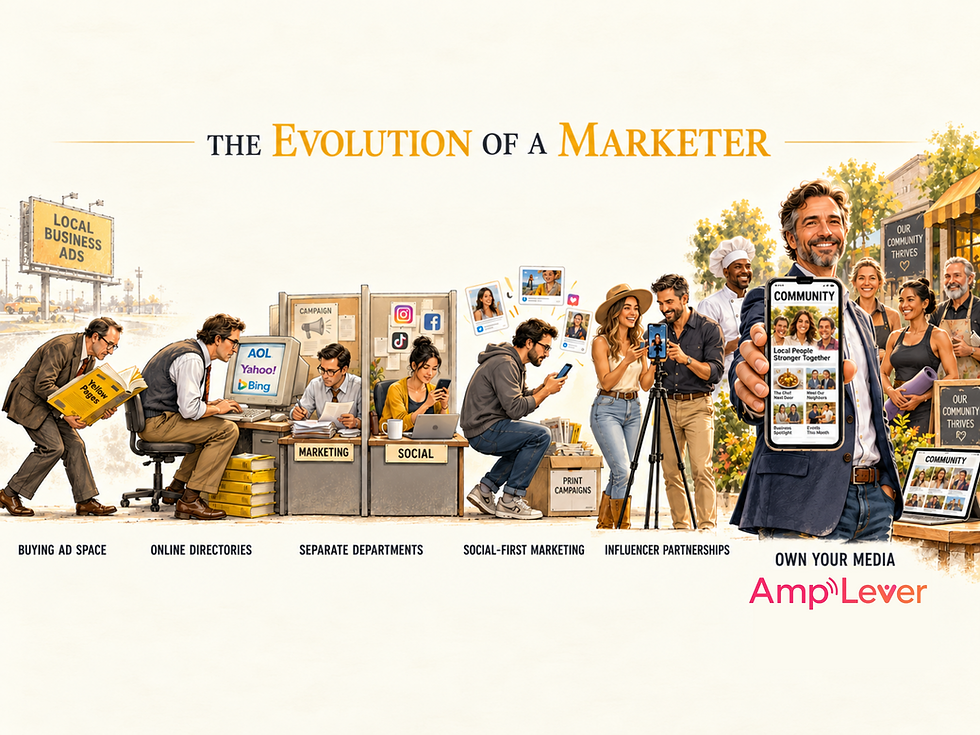
There was a time when marketing meant buying space in someone else's publication or on someone else's property. Businesses advertised in magazines, newspapers, the Yellow Pages, the White Pages, on billboards, at bus stops, and across television and radio. If you wanted customers to discover your business, you needed to put your message where people were already looking. And because there were so many places to advertise, businesses needed marketers to manage the process.
Marketing departments negotiated advertising rates, developed creative campaigns, managed media schedules, and evaluated which placements generated results. A local restaurant might advertise in the newspaper, purchase a Yellow Pages listing, sponsor a radio program, and place a billboard near a busy intersection. A national brand could multiply those activities across dozens of markets and hundreds of publications. The more complicated the media landscape became, the more valuable the people managing those advertising relationships appeared to be.
The model was relatively straightforward. Publishers and media companies attracted audiences, businesses paid to reach those audiences, and marketers managed the transaction. Businesses didn't own the newspaper, the billboard, or the radio station. They rented access to the people paying attention.
Then the internet arrived, and everyone thought marketing was about to change forever.
The Internet Changed the Medium, Not the Strategy
In its earliest commercial years, the internet looked surprisingly familiar. Instead of printed directories, consumers searched digital directories, web portals, and online listings. Businesses competed for visibility on AOL, Yahoo, and countless industry-specific websites, while search engines eventually made discovering businesses and information dramatically easier. The technology was new, but the underlying marketing model remained remarkably similar.
Businesses still needed to be listed where potential customers were searching. Marketers helped companies build websites, purchase banner advertisements, submit directory listings, and improve their visibility in search results. Search engine optimization and paid search introduced entirely new disciplines, creating additional demand for specialized marketing expertise. Instead of buying space in the Yellow Pages, businesses were increasingly buying attention across the digital landscape.
The internet made advertising more measurable, accessible, and scalable, but it didn't fundamentally change who controlled distribution. Businesses still depended on outside companies to help customers discover them. Those companies could change pricing, rankings, advertising policies, and the rules governing visibility. Marketers adapted by learning new systems and developing new services around them.
And then something happened that would change the marketing industry more profoundly than almost anything before it.
Social media arrived.
When Marketing and Social Media Were Two Different Departments
When social networks began attracting enormous audiences, many traditional marketers didn't immediately understand what to do with them. Facebook, Twitter, LinkedIn, and emerging social platforms didn't behave exactly like newspapers, directories, or conventional advertising channels. People weren't simply visiting these platforms to find products or consume professionally produced media. They were going there to connect with friends, share experiences, express opinions, and participate in conversations.
Some marketing organizations initially treated social media as a separate discipline. Companies developed social media teams alongside traditional marketing departments, often with different budgets, strategies, and performance measurements. Traditional marketers focused on advertising campaigns, lead generation, and established media channels, while social media specialists concentrated on followers, engagement, posting schedules, and community interaction. The distinction was so pronounced that businesses frequently advertised positions for separate marketing managers and social media managers.
Some established marketers were skeptical of the entire phenomenon. Why should a serious business invest resources in people posting pictures, sharing personal updates, and commenting on each other's lives? How could a company justify paying employees to spend their days on Facebook or Twitter? For professionals trained in conventional advertising, social media initially seemed less like a legitimate marketing channel and more like a distraction.
Eventually, however, the numbers became impossible to ignore. Millions of people were spending increasing amounts of time on social networks, and businesses wanted access to those audiences. Marketing departments began integrating social media into their broader strategies, and agencies developed new services to manage business accounts, produce posts, and grow followers. What had once been dismissed as a novelty became an essential part of modern marketing.
But something else happened during that transition.
Marketing became a never-ending content production business.

The Content Treadmill Was Born
Traditional advertising campaigns often had defined production schedules and distribution periods. A magazine advertisement could run for a month, a billboard might remain visible for an entire season, and a television commercial could be reused across multiple campaigns. Social media introduced a very different expectation. Businesses were suddenly encouraged to publish something new every day, sometimes multiple times a day, across several platforms.
Marketers developed content calendars, posting strategies, engagement campaigns, and social media management packages. They hired graphic designers, copywriters, video editors, community managers, and eventually entire production teams dedicated to keeping business accounts active. Every platform introduced its own preferred formats, recommended posting frequencies, and engagement practices. The result was an increasingly complicated operation built around producing and distributing an endless supply of content.
Then came the algorithms. Platforms began adjusting how posts appeared in users' feeds, often prioritizing content according to predicted relevance, engagement, and other signals rather than simply displaying everything chronologically. A business that had spent years building followers could discover that only a fraction of those followers were seeing its organic posts. Suddenly, the marketing department needed another strategy.
Marketers studied algorithm changes, experimented with new formats, adjusted publishing schedules, and developed tactics intended to improve reach. Businesses invested in video when platforms emphasized video, adopted short-form content when short-form content became popular, and changed their approaches when engagement patterns shifted. Each platform update created another reason to revisit the strategy, produce different content, or allocate additional resources. The business was constantly adapting to rules established by companies it did not control.
For marketing agencies, constant change created constant demand for new services. For business owners, it created a growing dependency.
That doesn't mean marketers deliberately designed the system to keep themselves employed. Many were doing exactly what their clients paid them to do: finding ways to reach customers through the channels available. But the commercial incentives were difficult to ignore. When success depends on continuously producing new content and responding to changing algorithms, the work rarely ends.
Your Followers Were Never Entirely Yours
Consider what happens when a business spends years building an audience on Facebook, Instagram, LinkedIn, or another social platform. Employees create content, agencies manage campaigns, advertising budgets support audience growth, and customers gradually begin following the company's account. The business celebrates reaching 1,000 followers, then 10,000, then perhaps 100,000. Those numbers begin appearing in presentations as evidence of marketing success.
But having followers on a platform doesn't mean owning the relationship in the same way a business controls its own customer database or membership system. The platform determines how feeds operate, which posts receive distribution, what types of content are permitted, and which advertising products businesses can purchase. Even when followers voluntarily choose to connect with a company, the platform's systems influence whether and when they encounter its messages. A business can invest heavily in attracting an audience without controlling its ability to reach that audience.
LinkedIn provides a useful example of how these dynamics have evolved. As the network has refined its feed ranking and emphasized professional relevance, authenticity, and meaningful engagement, marketers have had to reconsider how their content reaches followers and connections. There is no universal rule limiting businesses to reaching only their 500 most engaged followers, but the broader challenge remains real: having a large network does not guarantee that every connection will see every post. Visibility depends on systems that individual businesses do not control.
When organic reach declines, the familiar response is to develop another content strategy. Marketing teams analyze performance, study platform recommendations, experiment with formats, and sometimes recommend increasing paid advertising. The company may regain visibility, but its underlying dependence on the platform remains unchanged. It is still working to reach an audience inside someone else's system.
The business built the following. The platform controls much of the distribution.
And then another group of people entered the marketing industry and disrupted the entire conversation.
Along Came the Influencers
In the early days of influencer marketing, many traditional advertising professionals struggled to understand why businesses should pay ordinary people to post videos and photographs. These creators didn't necessarily have marketing degrees, advertising experience, or established media credentials. Some built audiences by documenting everyday life, reviewing products, sharing expertise, or simply entertaining people. From the perspective of conventional advertising, the approach could appear unpredictable and unprofessional.
But influencers understood something important about social media. People often pay attention to other people more readily than they pay attention to corporate advertisements. A creator with a loyal audience could introduce a product through an authentic conversation, personal recommendation, or entertaining demonstration. In some cases, that recommendation could generate extraordinary attention and commercial results.
Marketing agencies eventually recognized the opportunity. Influencer marketing departments emerged, brands developed creator partnership programs, and specialized agencies began managing relationships between businesses and online personalities. The industry created new systems for identifying influencers, negotiating compensation, measuring performance, and coordinating campaigns. What initially looked like a threat to traditional advertising became another established marketing discipline.
Yet the underlying model remained familiar. Businesses were still paying to reach audiences that other people had assembled. Instead of purchasing space in a newspaper or buying advertising impressions on Facebook, they were purchasing access to the trust and attention cultivated by individual creators. The influencer became another distribution channel, and marketers became responsible for managing that channel.

Then Artificial Intelligence Arrived
Artificial intelligence introduced another dramatic shift in the marketing industry. Tools capable of generating written content, images, videos, campaign concepts, and advertising variations began performing tasks that previously required substantial human effort. Work that once took hours could sometimes be completed in minutes. For marketing professionals whose services revolved around producing content, the implications were impossible to ignore.
Some marketers worried that artificial intelligence would replace portions of their work. Others immediately recognized an opportunity to create new services around AI adoption, prompt engineering, automated content production, and AI-assisted campaign management. Businesses were encouraged to use AI to produce more posts, develop more creative variations, and publish more frequently. The technology changed how content was created, but the familiar emphasis on content volume remained.
This created an interesting contradiction. If artificial intelligence makes content easier and less expensive to produce, then simply producing more content becomes a less distinctive competitive advantage. Businesses can now generate articles, images, captions, and promotional materials at a scale that would have been prohibitively expensive just a few years ago. As the internet fills with increasingly similar material, the challenge shifts from creating content to creating something people genuinely care about.
AI didn't make human stories less valuable. It made them more important.
And that brings us to one of the most revealing developments in modern marketing.

Cannes Lions 2026: Creators Became the Story
At Cannes Lions in June 2026, artificial intelligence remained an important subject across the advertising and marketing industry. But another major conversation centered on the expanding role of creators and influencers within the broader media economy. Creators were no longer being discussed exclusively as people who published sponsored posts or appeared in short promotional videos. Increasingly, they were operating production companies, developing intellectual property, advising brands, and building businesses around their audiences.
That evolution exposed a larger opportunity. Successful creators had learned to transform attention into relationships, products, services, communities, and commercial opportunities. Their value was no longer limited to the number of views they could generate for an advertiser. Some were becoming media companies in their own right.
For traditional marketers, this created another opportunity to develop services around an emerging industry. Creator partnerships, influencer production, talent management, and brand collaborations could all become new marketing programs. Agencies could help businesses navigate the increasingly complex relationship between creators, audiences, and commercial partnerships. But beneath the excitement surrounding these new models was a question that deserved much more attention.
What if businesses had been focusing on the wrong assignment all along?
The Assignment Was Never Likes, Followers, or Content
Think about the marketing objectives businesses have pursued over the past twenty years. More followers, more impressions, more engagement, more video views, more clicks, and more content have become familiar measures of progress. Entire marketing strategies have been developed around increasing those numbers. But none of those metrics, by themselves, represents the ultimate purpose of building a successful business.
The real assignment was always to develop relationships with people who have a reason to care about your organization. Businesses need customers who trust them, professional partners who recommend them, and communities that recognize their value. They need opportunities to participate in conversations, celebrate accomplishments, discover relevant information, and build connections with one another. Content can support those objectives, but content production is not the objective itself.
The assignment was always to build community.
Now you might be thinking that your marketing department already did that. After all, your business has Facebook followers, LinkedIn connections, Instagram engagement, email subscribers, and perhaps even a private online group. Your marketing team has spent years cultivating those audiences and developing strategies to keep them engaged. Surely that qualifies as building a community.
In some cases, it absolutely does. Good marketers have always understood the importance of relationships, customer loyalty, and community development. But there is a critical difference between building a community that your organization controls and cultivating an audience primarily through infrastructure owned by another company. That distinction determines who controls the experience, the distribution, and many of the commercial opportunities created by participation.
And no company illustrates that distinction more clearly than Facebook.

Mark Zuckerberg Understood the Assignment
During his 2018 appearance before the United States Senate, Mark Zuckerberg was asked how Facebook could sustain a business model that allowed people to use its services without paying. His answer was remarkably straightforward: “Senator, we run ads.” The exchange became memorable because it explained an enormous business in just a few words. Facebook created a platform where people could connect, communicate, and share content, then generated revenue by selling advertising around that activity.
But there's another part of the business model that deserves attention. Facebook didn't hire millions of writers to produce every personal update, photograph, community discussion, or business announcement appearing on its platform. Its users created much of the content that made the platform valuable. Friends shared milestones, families posted photographs, community groups organized activities, and businesses promoted their products and services.
Facebook provided the infrastructure, while its users supplied an enormous amount of the participation. The company developed systems that encouraged people to return, contribute, interact, and invite others into their networks. As participation increased, the platform became more valuable to users and advertisers alike. That combination of user-generated content, network effects, and advertising helped create one of the world's most influential media businesses.
Mark Zuckerberg built the platform. People like you built much of the community.
Meanwhile, businesses paid marketers to help them attract followers, create content, and advertise within that same environment. The platforms generated revenue from the attention and participation those activities helped produce. Businesses could benefit from the exposure, but the underlying infrastructure remained outside their control. They were participating in a media economy that someone else owned.
Now imagine applying a similar principle to your own business or community.
You Don't Need to Build Another Facebook
Let's be clear about something. Launching a social network capable of competing directly with Facebook, Instagram, LinkedIn, or Reddit would be an enormous undertaking. These companies benefit from established networks, sophisticated technology, massive financial resources, and billions of existing relationships. Most businesses have neither the resources nor the strategic reason to challenge them directly. Fortunately, building your own community doesn't require recreating a global social media platform.
What if you focused on something much smaller and more relevant? Instead of trying to become the next Facebook, imagine becoming the central source of stories, recognition, and professional connections within your own community. That community might be a city, a neighborhood, an industry, a trade association, or a network of local businesses. You already understand the people, the relationships, and the subjects that matter to them.
Facebook's scale is extraordinary, but its size also creates an opportunity for more specialized experiences. A neighborhood restaurant doesn't necessarily need millions of strangers around the world to see its latest menu. It needs local customers, nearby businesses, and people who are genuinely interested in what is happening in their community. A regional contractor may benefit more from being recognized by local homeowners and professional referral partners than from accumulating thousands of unrelated social media followers.
The opportunity isn't to build a bigger Facebook. It's to build something more relevant to the people you already serve.
And what if you could do that using a publishing model built around the participation of your community?

Imagine Becoming the Press for Your Community
Picture owning a professionally branded digital magazine dedicated to the businesses, professionals, and organizations in your city. Instead of spending your time creating endless promotional posts about your own company, you begin inviting local businesses to share their stories. Restaurants discuss their new menus, architects showcase completed projects, entrepreneurs explain their innovations, and community leaders celebrate important milestones. Your publication becomes a place where people can discover and recognize the individuals making their community interesting.
Now imagine a restaurant owner preparing to introduce a new seasonal menu. On Facebook, that owner can publish an announcement at any hour, hoping the algorithm delivers it to interested customers. In your community magazine, that same owner could participate in a featured interview about the new menu, the inspiration behind it, and the people responsible for creating it. Instead of another short-lived social media post, the restaurant receives a shareable article that tells a more complete story.
The same model could work for a local venue announcing a live band, a business hosting a guest speaker, or an entrepreneur celebrating a company anniversary. A designer could showcase a completed project, a nonprofit could explain an upcoming fundraiser, and a local business association could recognize outstanding members. Each story contributes to a growing publication that reflects the people and activities within the community. The magazine becomes more useful as participation expands.
But here's where the opportunity becomes especially interesting.
You don't have to personally interview everyone.
The Community Creates the Content
Traditional magazine publishing generally depends on writers, reporters, and editors to produce the publication's content. That approach can be valuable, but it also introduces significant expenses and limits how many stories a small team can produce. A community-focused publication built around contributor interviews can operate differently. Instead of producing every article internally, the publisher can invite community members to participate directly in telling their own stories.
This is the foundation of AmpLever's Participation Media model. A magazine publisher invites a business owner, professional, or community leader to participate in a featured interview. The invitee chooses the questions they want to answer, submits their responses, and completes a self-service publishing process. The publisher can focus on developing relationships and maintaining appropriate editorial standards rather than personally writing every feature.
Once the article is published, the featured business has a natural reason to share it. Its owners, employees, customers, friends, and professional partners may all be interested in seeing the story. When those people visit the article, they also discover the publication and the organization behind it. Every new feature creates another opportunity for the magazine to reach people through the existing relationships of its contributors.
Your community creates the content. Your community shares the content. Their networks discover YOU.
This changes the relationship between marketing and publishing. Instead of continuously producing promotional material and hoping strangers engage with it, the organization creates opportunities for people to participate in something that matters to them personally. Recognition becomes a reason to contribute, and participation becomes a reason to share. The publication can grow through the collective activity of the community rather than depending entirely on the publisher's content production budget.

What If Your Community Could Participate 24/7?
One of Facebook's most powerful features is that people don't need to wait for permission from a marketing department to share ordinary updates. A business owner can open the platform, create a post, and publish information whenever it becomes relevant. That convenience encourages participation because the platform fits into people's existing routines. Businesses can announce new products, celebrate achievements, and share information without arranging an appointment with a reporter.
Now imagine extending that convenience to your own community magazine. A local business owner receives an invitation to participate in a featured interview and completes it when their schedule allows. They might share the story behind a new restaurant, introduce a recently hired employee, announce an expansion, or celebrate a milestone. Instead of requiring the publisher to conduct every conversation, the process allows contributors to provide their own material through a structured publishing experience.
The result is a more accessible form of community publishing. People who might never receive coverage from a traditional newspaper or national magazine can have opportunities to share meaningful stories within a relevant publication. The publisher can invite more participants without multiplying the workload associated with conducting individual interviews. And the community gains a growing collection of stories about the people, businesses, and organizations around it.
That doesn't mean every submission should automatically be published without standards or oversight. A responsible publisher still needs to establish appropriate participation policies, distinguish sponsored material from independent editorial content, and maintain the credibility of the magazine. But those responsibilities are different from having to personally create every article. Technology can reduce the administrative burden while preserving the publisher's role in shaping the publication.
What If You Earned the Revenue Instead?
Let's return to the business model that helped make Facebook so successful. The platform attracted participation, users created and shared content, and the company developed advertising products around the resulting audience. Businesses paid for opportunities to reach people within that environment. The platform owner benefited commercially from the activity taking place on its infrastructure.
Now imagine operating your own community publication with a similar understanding of participation and commercial value. As your magazine develops a recognizable audience, you could offer advertising placements to businesses that want to reach its readers. You could develop sponsored features, clearly labeled advertorial opportunities, and commercial partnerships that complement the publication's editorial purpose. Depending on eligibility and platform requirements, digital advertising networks such as Google AdSense could provide another potential revenue source.
Over time, the opportunities could extend beyond conventional advertising. Your publication might recognize outstanding local businesses through annual awards, develop sponsorship packages around those recognition programs, or host events that bring featured businesses together. Industry magazines could create commercial partnerships with conferences, associations, and professional organizations. A publication that consistently introduces people to one another may develop business opportunities that go well beyond selling advertising impressions.
None of these revenue sources is automatic, and launching a magazine does not guarantee an audience or advertising income. Publishers still need to create value, develop relationships, attract readers, and establish sustainable commercial offerings. But there is an important difference between spending your entire marketing budget purchasing access to someone else's community and investing in a media property that your own organization operates. One primarily rents attention, while the other can help build a lasting business asset.
Instead of paying indefinitely to participate in someone else's media business, what if your marketing helped build your own?
The Next Evolution of Marketing Isn't More Content
We've spent decades watching marketing evolve from print advertising to digital directories, from social media management to influencer programs, and from influencer partnerships to AI-powered content production. Every transition has introduced useful tools, new opportunities, and legitimate innovations. But every transition has also encouraged businesses to invest more resources in mastering someone else's distribution system. The underlying dependence has remained surprisingly consistent.
Artificial intelligence may be the technology that finally forces businesses to reconsider that approach. When everyone can generate more content at lower cost, the competitive advantage of simply producing content begins to diminish. The harder challenge is developing relationships, earning trust, creating meaningful participation, and giving people a reason to return. Those are the foundations of community, and they cannot be manufactured simply by increasing the number of posts on a content calendar.
The future of marketing may belong to organizations that stop thinking exclusively like advertisers and start thinking like publishers and community builders. Rather than asking how to produce more content for Facebook, they can ask how to create more opportunities for their own customers and partners to participate. Rather than measuring success only through followers and impressions, they can develop media assets that strengthen relationships and create direct commercial opportunities. Rather than depending entirely on outside platforms for visibility, they can establish destinations that people have a reason to visit and share.
This doesn't mean businesses should abandon social media, advertising agencies, or professional marketers. Those channels and professionals can remain valuable parts of a successful growth strategy. The difference is what they're working to build. Social platforms can become distribution channels that introduce people to your community, rather than the only places where your community exists.

You Could Be Running Your Own Magazine in the Next 5–7 Business Days
For generations, becoming a magazine publisher required significant financial resources, production infrastructure, and editorial staffing. Today, digital publishing technology makes it possible for businesses and community leaders to establish branded publications without building a traditional newsroom. AmpLever was developed to make that opportunity more accessible through a self-service, user-generated content publishing model. Instead of requiring the publisher to create every story, the platform enables the community to participate directly.
Imagine what that could mean for your business over the next year. You could be recognizing local entrepreneurs, celebrating professional milestones, showcasing new products, and introducing people who might otherwise never meet. Every featured contributor could become a new relationship, a potential referral partner, and another opportunity for people to discover your publication. Over time, the magazine could become a recognizable source of community stories and professional visibility.
With AmpLever, a streamlined community magazine can be designed to operate in less than 20 minutes a day, depending on the publisher's editorial requirements and participation volume. Our launch process is designed to help eligible publishers get their branded digital magazines running in approximately 5–7 business days, once the necessary setup materials and decisions are in place. The goal is not to replace every function of traditional marketing, but to give businesses something that has historically been missing from their strategy. It's the opportunity to operate their own publishing platform around the people and relationships that already matter to them.
So here's the question every business owner should be asking their marketing department.
Are we spending our marketing budget building our community, or are we spending it building someone else's platform?
Because the assignment was never to create more content.
The assignment was always to build community.
And perhaps it's time you owned the platform where that community comes together.
Ready to Become the Publisher of Your Own Community?
Discover how AmpLever can help you launch a branded, user-generated content digital magazine in as little as 5–7 business days. Give your customers, local businesses, professional partners, and community leaders a place to tell their stories, celebrate their achievements, and introduce their networks to your brand. Instead of creating an endless stream of promotional content, start building a publishing asset designed around the participation of the people you already serve.
Stop renting attention. Start building your own community.
Learn more about launching your own AmpLever digital magazine:


Comments